

Visit Pas de Calais
The Pas-de-Calais department in northern France spans three diverse zones: the dramatic Opal Coast with its chalk cliffs, the lush Audomarois Marshes near Saint-Omer, and Lens's industrial Mining Basin. Pas-de-Calais is an extraordinary microcosm of France itself, brimming with UNESCO-listed monuments and natural wonders, cultural hotspots, historical landmarks and Remembrance trails. Maybe now is a good time for us to explore...
We did a little research ahead of planning a visit, first to see which area Pas-de-Calais actually covers. It is always good to know where you are planning to go. And secondly, we want to make the most of our visit and see spaces that really interest us.
1: The Opal Coast
Stretching from Calais to Berck-sur-Mer, the Côte d’Opale unfolds over 120km of dune-dusted beaches and sheltered bays crowned by the twin cliffs of Cap Gris-Nez and Cap Blanc-Nez. Once a glitzy retreat for well-heeled Parisians, its daisy-chain of seaside resorts, each trimmed with a rainbow of Belle-Époque villas, is now the playground of families and savvy weekenders in search of sea, sun and seafood - and a motley crew of land sailors and surf bunnies.
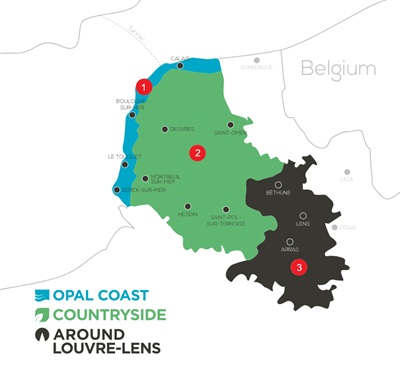
2: The Audomarrois Marshes
France's last cultivated wetland and a UNESCO-designated biosphere reserve, the Marais Audomarois is a haven for rare wildlife and endangered bird species. Amid this network of placid waterways, time stands still, inviting twitchers and detached observers to pause, recharge and be one with the natural world. Beyond this peaceful sanctuary, a sweeping patchwork of forests and bocages criss-crosses the hinterland from Saint-Omer to Montreuil-sur-Mer to the Sept Vallées.
3: Around Louvre-Lens
Shaped by centuries of coal extraction and steeped in tradition, Lens and its surroundings today have pulled off quite the balancing act, successfully safeguarding and breathing new life into their UNESCO-protected mining heritage. Over the years, the area's sprawling rockscape and slag heaps have been rather imaginatively reclaimed as vineyards, farmland and even a dry ski slope, while its long-deserted pits have made way for interpretation centres, art hubs and, since 2012, the acclaimed Louvre-Lens, now France's third most-visited museum outside Paris.
If we are going for a few days, we would have to decide between a pitstop in places or selected holidays in each area, depending on how we wish to travel. Personally, I would prefer a separate visit for each area, allowing time to explore in detail. You can fly to France, but routes are not yet direct, so the fastest option is to take a train via central London, which takes about 3 hours and 5 minutes in total. This area of France is accessible via Eurostar or ferry crossings from Dover. In Calais and surrounding towns, all public transport is free of charge. You do not even need a ticket to hop on a bus. Bus shuttles from the ferry terminal run every 22 minutes in the morning and every 11 minutes in the afternoon.
Start your discovery today by visiting Visit Pas de Calais today.