

Newcastle: A Street Food Adventure Through History
Newcastle upon Tyne is one of those places where you can discover their history through food, and I love those kinds of cities. Around every corner, there's a story to tell, whether it's hidden in a medieval market, tucked inside a centuries-old bakery tradition, or served up in a humble sandwich that generations of locals have enjoyed before heading off to work.
Newcastle upon Tyne sits on the north bank of the River Tyne in Northeast England, around 100 miles south of Edinburgh and 280 miles north of London. Once famous for coal mining, engineering and shipbuilding, Newcastle has transformed itself into one of Britain's most exciting city-break destinations. The city takes its name from the "New Castle" built by Robert Curthose, son of William the Conqueror, in 1080. Today, visitors come for the iconic bridges, vibrant nightlife, rich history and, increasingly, its impressive food scene. The best way to explore Newcastle is on foot and, preferably, with an empty stomach.
My journey began in the Bigg Market, one of the oldest parts of the city. 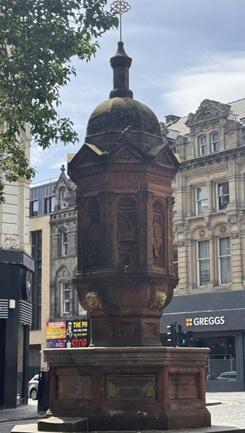
An outstanding feature in the Bigg Market is the Rutherford Memorial Fountain, which is surrounded by bustling bars and eateries - slightly out of place, yet somehow perfectly at home. The fountain was originally erected outside Newcastle Cathedral in St Nicholas' Square, before being moved to the Bigg Market in 1901, to make way for a new statue of Queen Victoria.
In fact, this is the third city-centre location it has occupied during its lifetime, making it something of a well-travelled Newcastle landmark. Built during the Victorian era, the fountain was one of many installed across the city to provide clean drinking water for Newcastle's rapidly growing working-class population, in the hope that it would encourage them to drink less beer. Over the years, the memorial fell into disrepair, and the water supply was eventually switched off. Thankfully, Newcastle City Council recognised its importance and removed it in 1996 for conservation work as part of the wider regeneration of the Bigg Market. Two years later, with support from Northumbrian Water, it was carefully restored and installed in its current position.
Sadly, water no longer flows from the fountain, but as I stood looking at it, I couldn't help but smile at the irony. More than a century ago, it was built to encourage Newcastle's residents to drink clean water. Today, it stands proudly in the middle of one of the city's most popular nightlife areas, seemingly still trying its best to persuade locals to choose water over beer.
A short stroll away is the magnificent Grainger Market, which opened in 1835 as part of Richard Grainger's ambitious redevelopment of Newcastle. This vast indoor market attracts many visitors to the city, and there is something wonderfully chaotic about it. One moment you're admiring Victorian architecture, the next you're distracted by the smell of freshly baked bread, artisan coffee, sizzling street food and cakes that are far too large to be sensible.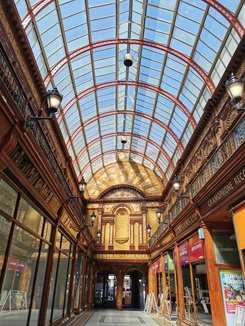
The market is home to over a hundred independent traders and has become a food lover's paradise. Here, traditional butchers and bakers sit alongside international street food vendors serving flavours from around the globe. It is also home to the original Marks & Spencer Penny Bazaar. It's hard to imagine that one of Britain's most famous retailers began life as a humble market stall in Newcastle.
While Newcastle embraces contemporary food trends, it hasn't forgotten its roots. Nowhere is that more obvious than with the legendary ham and pease pudding stottie. If Newcastle has an official street food, this might just be it. For anyone unfamiliar with a stottie, imagine a bread roll that has been going to the gym for several decades. Dense, substantial and gloriously filling, it was originally designed to sustain miners, shipbuilders and industrial workers through long shifts. Filled with thick slices of ham and creamy pease pudding made from yellow split peas, it remains a true taste of the Northeast. Simple? Yes. Fancy? Not remotely. Delicious? Absolutely.
A little shop I couldn't resist was Pet Lamb Patisserie, founded in 2009 by best friends Katie and Kay. The business began with little more than determination, a love of baking and a folding table. The pair spent months perfecting recipes, whipping, beating and piping their way through countless batches of cupcakes and brownies before taking their sweet creations out onto the streets of Newcastle. In 2012, gaining a loyal following, they realised their dream of opening a permanent shop in Grainger Market. Today, you'll still find Katie and Kay hard at work behind the counter, baking fresh on site and filling the market with the irresistible smell of chocolate, sugar and butter. Their display cabinet is brimming with cupcakes, blondies, brownies, and traybakes, all competing for attention, each looking more tempting than the last. I was immediately drawn to their famous chocolate brownie. Rich, gooey and unapologetically indulgent, it's the sort of treat that makes you close your eyes after the first bite and briefly forget every good intention you had about eating sensibly.
No food journey through Newcastle would be complete without mentioning Greggs. Founded by John Gregg as a bakery delivery business in 1939, the company has grown into a national institution. The first Greggs shop opened on Gosforth High Street in 1951, and today Newcastle is home to around 32 Greggs shops. Because Newcastle is the birthplace of the brand, it has one of the highest concentrations of Greggs stores anywhere in the UK. Around Central Station, Monument and the city's main shopping streets, it sometimes feels as though you're never more than a few minutes away from a sausage roll. While the sausage roll itself wasn't invented in Newcastle, Greggs transformed it into a British icon. Millions are sold every week across the country, but here in the city where it all began, it still feels very much like a local success story.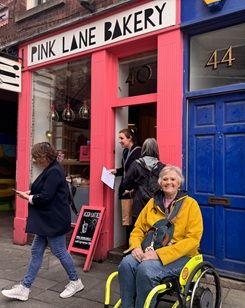
From Grainger Market, I wandered towards Pink Lane, one of Newcastle's oldest streets. Most people hurry through on their way to Central Station without realising they're walking alongside the route of the medieval town walls. The lane takes its name from the long-vanished Pink Tower, part of Newcastle's ancient defences. Today, Pink Lane has become one of the city's food hotspots and is home to Pink Lane Bakery. The smell alone is enough to stop you in your tracks. Fresh sourdough, buttery pastries and beautifully crafted loaves emerge from the ovens daily. It's the sort of place where you pop in for one thing and leave carrying three bags and a mild sense of guilt. The bakery perfectly reflects Newcastle's evolving food scene. Traditional baking skills remain at its heart, but there is also a willingness to innovate and embrace new ideas. Interestingly, the bakery now operates from the former Baker's Yard site once associated with Greggs, creating a fascinating link between Newcastle's old and new baking traditions.
As the afternoon unfolded, I headed into Chinatown, passing beneath the magnificent Chinese Arch. Newcastle's Chinatown is one of the largest in England and offers an incredible range of flavours from across Asia. With aromas drifting from the restaurants, the walk through made me hungry all over again. What I particularly enjoyed was the contrast with the earlier streets - one moment I was immersed in Newcastle's medieval trading history, and the next I was exploring flavours from China, Japan, Korea and beyond. It is a reminder that Newcastle's story is still being written.
Just around the corner from Chinatown lies one of the city's most remarkable dining experiences. Blackfriars Restaurant occupies part of a medieval Dominican friary founded in 1239. 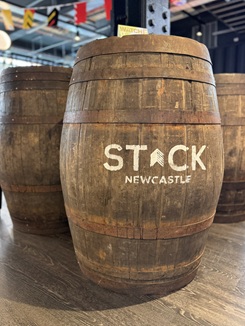
For a taste of modern Newcastle, I finish at STACK. Built from shipping containers, it perfectly reflects the city's ability to reinvent itself. What began as a temporary project quickly became one of Newcastle's biggest success stories. Independent food vendors, local drinks, live music and a lively atmosphere transformed a vacant city-centre site into a thriving social hub. One of my favourite discoveries inside STACK was 'Boa Down'. With so many tempting food vendors competing for attention, choosing where to eat can feel like a challenge, but the sight of pillowy soft bao buns quickly made my decision for me.
The menu takes inspiration from East Asian Street Food, serving fluffy steamed bao buns packed with flavour, crispy-bottomed gyoza with just the right amount of crunch, and a wonderfully comforting katsu curry. The curry arrived golden and crisp, smothered in a rich sauce that disappeared far more quickly than I intended. It was exactly the sort of food you want after a day exploring the city. What I loved most was how Boa Down perfectly reflects Newcastle's modern food scene. Just a few streets away, I had been learning about medieval markets and traditional stotties.
Here, inside a collection of shipping containers, I was enjoying flavours inspired by the streets of Tokyo and Seoul. It sums up Newcastle brilliantly - a city that proudly celebrates its heritage while enthusiastically embracing influences from around the world. If you're visiting STACK and can only choose one dish, I'd strongly recommend the katsu curry.
What strikes me most about Newcastle's food scene is how naturally the old and new sit side by side. One minute you're eating a centuries-old local recipe. Next, you're sampling food inspired by cultures from around the world. Medieval markets stand alongside artisan bakeries. Historic pubs share streets with contemporary food halls.
Food is often described as a way to understand a place, and nowhere demonstrates that better than Newcastle. Every bite tells a story. Every street reveals another layer of the city's past. From medieval grain traders in the Bigg Market to artisan bakers on Pink Lane, from a humble ham and pease pudding stottie to the nation's favourite Greggs sausage roll, Newcastle's food scene is a celebration of the people who built the city and those who continue to shape it today. Just make sure you arrive hungry.