

An Accessible Journey Through Bonn
Bonn: Beethoven, Baroque Beauty and an Accessible Journey Through Germany's Former Capital*.
Some cities shout for your attention. Bonn simply smiles, takes your hand and quietly says, "Come and have a look around".
Perched gracefully on the banks of the Rhine, Bonn often finds itself overshadowed by its larger neighbour, Cologne. Yet after spending time here, I found myself wondering why so many visitors rush straight past Bonn, which has a warmth that grows on you. It's elegant without being pretentious, steeped in history yet refreshingly relaxed, and, from a wheelchair user's perspective, surprisingly easy to explore.
As someone who now experiences every destination on wheels rather than walking boots, I've learnt that the true character of a city isn't measured by the number of attractions it has. It's about whether it welcomes everyone - and Bonn certainly made me feel that it did.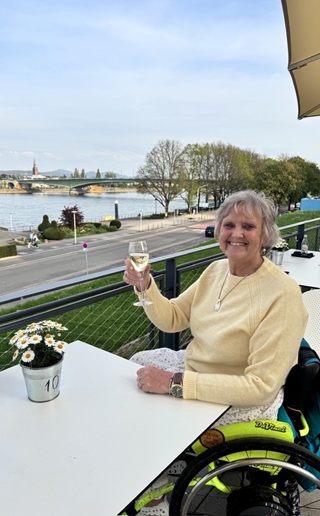
This is a city that has witnessed over 2,000 years of history. Long before Beethoven filled concert halls with his music, Roman soldiers marched through Castra Bonnensia, their fortress guarding this important stretch of the Rhine. Archaeologists have even uncovered evidence of humans living here around 14,000 years ago. Vikings later sailed up the Rhine, leaving destruction in their wake, before the Holy Roman Empire transformed Bonn into a city of magnificent Baroque architecture.
Napoleon arrived, Prussia followed, and eventually Bonn found itself at the centre of modern German history as the capital of West Germany, until reunification in 1990.
When the German parliament voted to return to Berlin, many feared Bonn would fade into obscurity, but quite the opposite happened. Today, the city is thriving, home to international organisations, a respected university and an enviable quality of life.
The first thing I noticed was how manageable Bonn feels. Unlike many historic European cities where uneven cobbles can leave your fillings rattling, much of the central area is pleasantly accessible. Wide pavements, dropped kerbs, and pedestrianised streets made exploring refreshingly straightforward. It allowed me to do what I enjoy most when travelling - slow down and simply absorb the atmosphere.
My base was the Dorint Hotel, perfectly positioned beside the Rhine. The location couldn't have been better, allowing me to reach the old town, museums, and riverside promenade without needing to use transport. My accessible room featured a spacious wet room with plenty of manoeuvring space. The only disappointment was the shower seating. Rather than a proper shower chair, the hotel could only provide a small stool, making transfers more challenging than necessary. It's a reminder that accessibility isn't simply about ticking boxes. The little details often make the biggest difference.
One of Bonn's greatest treasures is undoubtedly its riverside. The Rhine flows confidently through the city, with broad pathways perfect for wheelchair users, leisurely strollers, and cyclists alike. 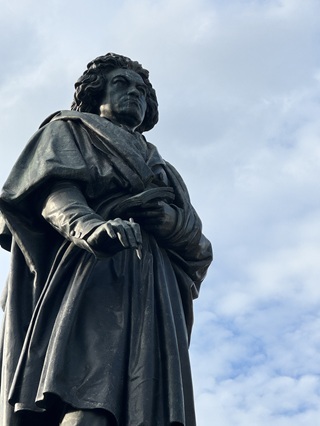
Ludwig van Beethoven was born here in 1770, and his presence still echoes throughout the city. His imposing statue dominates Münsterplatz, standing proudly before the impressive cathedral. Looking at the monument, I couldn't help smiling at one of history's more amusing diplomatic mishaps. When Queen Victoria and Prince Albert travelled to Bonn in 1845 to unveil the statue, someone had made a rather unfortunate error. As the covering dropped away, Beethoven was revealed... with his back firmly facing the royal balcony. Queen Victoria politely described the incident in her diary as 'unfortunate', while the King of Prussia was reportedly horrified. The ever-quick-witted Alexander von Humboldt broke the awkward silence by remarking, "He's always been rather a rough fellow." I love those little stories that make history feel wonderfully human.
Bonn is home to many museums and art galleries. LVR-LandesMuseum Bonn. One of Germany's oldest museums, it takes visitors on an engaging journey through 400,000 years of Rhineland history. Highlights include remarkable archaeological discoveries and the world-famous original Neanderthal skeleton. The spacious galleries, lifts and thoughtful layout made it an enjoyable experience from my wheelchair, proving that accessibility and outstanding museum design can happily go hand in hand. If you're fortunate enough to visit during late April, Bonn transforms into something quite magical. The streets of the Altstadt become a tunnel of pink cherry blossom, attracting photographers from around the world. Cars almost disappear as people wander beneath the blossom-covered streets, cameras permanently raised towards the sky. Cafés spill onto the pavements, conversations slow down, and somehow everyone seems just a little happier. It's one of those fleeting spectacles that lasts barely a fortnight before the petals drift away like confetti.
You shouldn't leave Bonn without visiting the Haribo shop near Münsterplatz. After all, Haribo was founded here, its name cleverly coined by founder Hans Riegel of Bonn. The name "Haribo" is a syllabic abbreviation formed from his name. Walking - or rolling - through shelves piled high with every imaginable variety of gummy sweets brings out the child in everyone.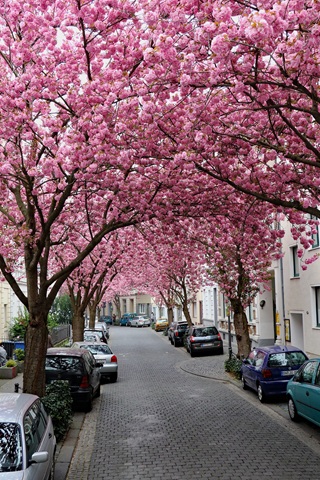
Food is another highlight. I couldn't resist dining at Gasthaus im Stiefel, a wonderfully traditional German inn famous for its authentic Sauerbraten. It's one of the few remaining places serving the traditional horse-meat version of this classic Rhineland dish, marinated for days in red wine, vinegar, juniper berries, cloves, and aromatic spices before being slow-cooked to melting tenderness. The restaurant itself happily accommodates wheelchair users, although there are no accessible toilets. It's worth planning ahead and using facilities in one of the larger nearby hotels before settling down to enjoy your meal.
One thing I particularly appreciated throughout Bonn was how calm everything felt. There wasn't the frantic rush found in many European capitals. Instead, students cycled between lectures at the university, families picnicked beside the Rhine, and locals lingered over coffee rather than hurrying to the next attraction. Bonn may no longer be Germany's capital, but perhaps that's exactly why it feels so comfortable in its own skin. It doesn't need to impress anyone. It simply gets on with being one of Germany's most charming, cultured and surprisingly accessible cities. Sometimes the places we remember most aren't the loudest or the grandest. They're the ones who quietly make us feel welcome. For me, Bonn did exactly that.
*Germany's most famous and historically prominent capital has always been Berlin. However, during the Cold War and the country's division, the Federal Republic of Germany (West Germany) designated the city of Bonn as its provisional capital from 1949 until 1990.