

Where Three Countries Meet
There are some places in Europe that demand your attention. Paris has the Eiffel Tower, Rome has the Colosseum, and Bavaria has enough castles and mountains to fill several postcards. And then there is Saarland. Tucked away in southwest Germany, bordering France and Luxembourg, Saarland is one of those places easily overlooked on the map. But for travellers ready to explore, that would be a mistake. Covering approximately 2,570 square kilometres and home to about one million people, Saarland may be small, but it is packed with character.
German and French influences mingle with a fascinating industrial heritage, vast forests, rivers and some rather spectacular countryside. 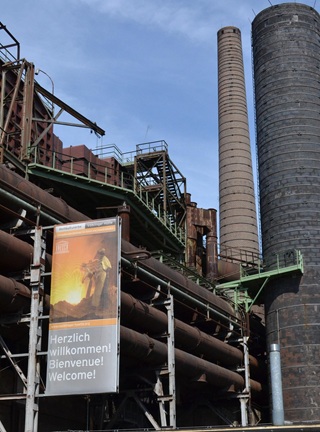
A Land Between Germany and France
Saarland's location has shaped its identity. France and Germany fought over this region for many years, not least because of its valuable coal and steel industries. Following both the First and Second World Wars, Saarland came under French administration for periods of time. Eventually its future was decided by the people who lived here. Following a referendum, Saarland became part of West Germany in 1957. The complicated history has left behind something rather lovely: a region that feels distinctly German while carrying more than a hint of France. You notice it in the food, architecture and relaxed café culture. Nobody seems in too much of a hurry. I can work with that.
Saarland's capital, Saarbrücken, is the largest city and makes an excellent base for exploring. It isn’t a city that overwhelms you with famous landmarks. Instead, it quietly gets on with being rather pleasant. The Saar River runs through the city, creating green spaces for walking, wheeling or simply sitting and watching the world go by. Paths, parks and bars line sections of the river and, when the sun appears, people spill outside to enjoy them. Head into the old town, and you will find St. Johanner Markt, a lively square surrounded by cafés, restaurants, pubs and independent shops.
During the summer, tables are spread across the square, and the French influence becomes particularly noticeable. Another architectural highlight is the Ludwigskirche, regarded as one of Germany's finest Baroque Protestant churches. But my biggest surprise came just outside Saarbrücken.
Steel, Fire and a Forest Called Paradise
The highlight of my recent visit was the extraordinary Völklinger Hütte UNESCO World Heritage Site. 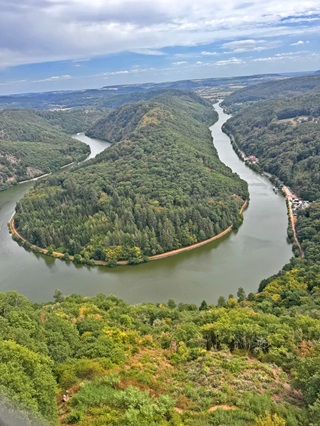
Taking a guided tour helped me understand the sheer scale of what happened here.
More than 1,500 people once worked at this site, and films around the complex bring their stories vividly to life. Watching historic footage of men working around the coking plant was particularly powerful. Hard coal was converted into coke for the iron-making process. The heat, dust, flames and physical demands must have been relentless.
Standing there today, it is difficult to imagine people spending entire shifts working in such conditions. Then comes one of the site's most unexpected contrasts. Nature is reclaiming parts of the old ironworks.
An area wonderfully known as 'Paradise' has been allowed to grow wild. Trees and plants weave their way around the old steel structures, birds have returned, and wildlife is flourishing where heavy industry once dominated. Steel and nature shouldn't really work together. Yet somehow, they do. Völklinger Hütte is also easily reached by public transport, making it possible to visit without a car.
Above the Great Bend
After all that industrial history, it was time to discover Saarland's greener side. Around a 45-minute drive from Saarbrücken is one of the region's most famous natural attractions: the Saarschleife, or Great Bend of the Saar. At this point, the Saar River performs an enormous horseshoe turn through the forested landscape near Mettlach. It is Saarland's signature view and, when you see it from above, you understand why
For me, one of the best ways to experience it is from the Treetop Walk Saarschleife. The 1,250-metre walkway gently climbs through mixed deciduous forest before reaching an impressive 42-metre-high observation tower. And more importantly for me, it's accessible. Rather than stairs, the tower uses a continuously rising ramp with a maximum gradient of around six per cent, making it suitable for wheelchair users and families with pushchairs. 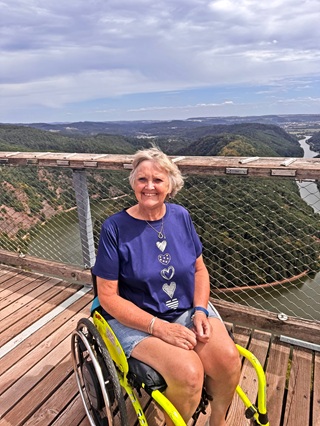
As you climb, new views appear between the trees. Take your time because every level seems to reveal something different. Then you reach the top. The view across the Saar-Hunsrück Nature Park is magnificent. Far below, the Saar curls dramatically around wooded hills and, on a clear day, you can see towards the Vosges Mountains. It is one of those moments when you stop talking. Yes, even me! There is also a wonderful play area for children, making the Treetop Walk a great option for families and multi-generational groups.
Small State, Big Surprise
Saarland probably isn't the first place most British travellers think about when planning a German holiday. Perhaps that's part of its charm. You can wander beside the Saar in Saarbrücken, explore one of Europe's most extraordinary industrial heritage sites and then find yourself high above the Saarschleife surrounded by forest.
And then there is its location. With France and Luxembourg so close, crossing an international border can become part of the day's adventure rather than a major expedition. For anyone planning a European road trip, it opens up all sorts of possibilities. For rail travellers, Saarbrücken also makes an excellent stopping point when exploring this corner of Europe. But I wouldn't treat Saarland simply as somewhere to pass through.
Stay for a while. Explore its industrial past, enjoy its café culture, follow the river and head into the forests. Saarland may be small, but it manages to squeeze an awful lot into its little corner of Germany. And sometimes the places you weren't quite sure about before you arrived turn out to be the ones you're rather glad you discovered.